

The exhausting paradigm of fashion, where social status is broadcasted through oversized logos, glittering brand names, and glaring metallic tags, surrounds us with an inescapable visual noise. The scenes we encounter on the streets, in display windows, or at exclusive events are often built on how loudly a brand can scream, rather than the honesty of the material. This dictatorial aesthetic, which entirely sidelines the human body, the structural weight of the design, and the true character of the fabric, dictates walking in the shadow of a brand rather than actually wearing a garment. A quiet and dignified aesthetic that is secure in its own value is replaced by ostentatious declarations of identity, written in massive fonts and offered up for the fleeting approval of others.
Under this high-decibel visual siege of the fashion industry, the identity of a woman or the garment she wears should never be defined by the brand name plastered across it. The architectural weight of craftsmanship, the integrity of the form, and the intellectual stance of the design never need to hide behind a cold, metallic stamp. In a design universe that stands firmly in its own center, unconcerned with seeking validation, there is simply no room for those giant letters and shouting logos. When will we be free from the obligation to declare our identity to others in bold print? When you can be the protagonist of your own style, why be a walking billboard for someone else?

Hidden Codes and Inconspicuous Consumption
At this point, sociological studies examining consumer behavior present a very clear picture. As Berger and Ward detail in their research on Inconspicuous Consumption, luxury that possesses true depth and nobility never needs to shout; it merely whispers its presence. This approach, stripped of status anxiety and focused entirely on the mathematics of design and the material itself, breaks completely from the transient and noisy arena of fashion. Flashy cardboard tags are replaced by a coded and far more profound language, one that can only be deciphered at first glance by eyes that recognize true craftsmanship.
The true signature in the architecture of this new language is not an emblem stamped on the chest of a garment; it is hidden in the meticulously calculated crochet strokes, in the knotting techniques that resist replication, and in the precise ratio of empty space between the stitches. This high-character texture, entirely unattainable on the standardized production lines dictated by the market, forms the foundation of “Coded Luxury.” The power of the piece you wear stems not from using a brand name as a shield, but from the uncompromising, architectural seriousness behind it and the structural integrity brought by artisan hands. This quiet signature unequivocally declares the design’s origin without needing a single word.
The most tangible manifestation of coded luxury is the sheer honesty of the material and its direct contact with the skin. The cooling, dignified, and structured stance of the yarn is a far more powerful declaration of identity than any oversized logo. The way these premium materials drape over the body, the way they refract light, and their structured form that defies the years allow the design to express itself. As defined in the Stealth Luxury concept by Eckhardt and her colleagues, this aesthetic creates an ecosystem that is closed to the outside but inherently powerful within—a language read only by those who know.

An Unhurried Resistance Against the Roar of the Factory
Just behind this visual chaos of emblems and logos lies another, far more disturbing factor: auditory pollution. Fast fashion besieges the world not only with giant billboards but with endless production lines and the soulless, deafening mechanical roar of factories. This industrial cacophony, where millions of steel needles strike simultaneously, completely removing the human element, inevitably weaves a synthetic and hurried spirit into the very fabric of the clothing. The serene nature of craftsmanship is replaced by the ceaseless hum of machinery.
Standing in direct opposition to this industrial noise is the acoustic aesthetic and the state of unhurried craftsmanship we champion. The meditative, sensory, and quiet rhythm created when a hook meets a cotton thread, honoring every single stitch and effort, is a highly conscious step against the gears of a mechanized world. The tranquility of an artisan’s hyper-local production space is woven into every piece shaped in the quiet corners of small ateliers or homes as an unshakeable frequency. This is the music of a dignified production process—one that doesn’t need to shout, but is felt simply through its grounded presence.
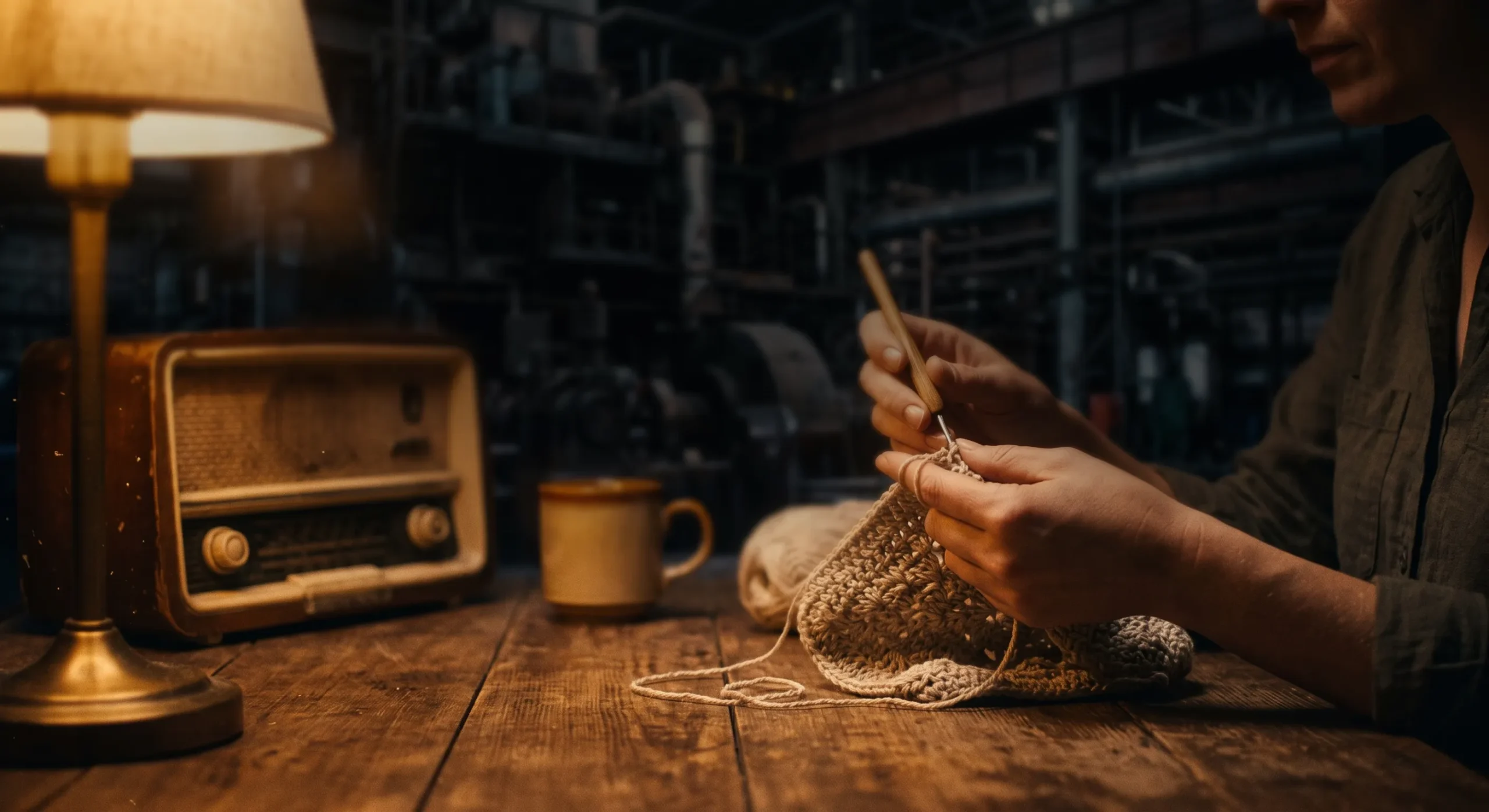
In his book In Praise of Slowness, Carl Honoré challenges the “cult of speed” that exhausts production processes while entirely destroying the soul of the object. In an era where everything is produced, consumed, and discarded in seconds, wearing a design that takes days of focused craftsmanship to create is a sturdy shield woven against that destructive velocity. Time spent with every meeting of the hook and yarn deepens the quality of the material, adding a maturity to the final design that industrial lines could never replicate. The value of a masterpiece is not measured by how quickly it is finished, but by how slowly and meticulously it is built.
Tactile Hunger and the Return to Reality
The modern individual, exhausted by the visual ostentation and the smooth yet deeply cold surfaces of screens, is suffering from a growing tactile hunger. As Juhani Pallasmaa notes in The Eyes of the Skin, his study on architecture and the senses, a culture focused solely on the visual disconnects humanity from its physical reality and the profound tactile experience of objects. The numb, flat surfaces of synthetic fabrics leave no trace on the memory of the skin. Against the dictatorship of the visual, feeling the heavy, voluminous, and realistic texture of a material pulls the mind out of that virtual noise and anchors it right in the center of reality.
This approach, which recenters the sense of touch, allows us to feel the true weight and form of an object. Feeling that three-dimensional, voluminous, and character-rich structure—built stitch by stitch by hand—at your fingertips is the most organic connection one can forge with the world. The very first moment a garment touches the body proves that the design is an architectural masterpiece appealing not just to the eyes, but to all the senses. This acoustic and tactile aesthetic creates a soul-soothing sanctuary, leaving the exhausting decibels of the outside world at the door.

The Courage to Be Silent and a Quiet Armor
Today, in an exhausting era where everyone is shouting at the top of their lungs and everything is consumed and forgotten in seconds, true power lies simply in the ability to remain silent. Against a consumer culture that constantly forces you to say something new, to draw more attention, and to stay on display at all times, the ability to exist within your own center is the greatest mental luxury the modern age can offer. Is the garment you wear just another megaphone joining the deafening noise of the world, or is it a thick armor transcending time, protecting your own silence and refined stance?
At this point, where visual vulgarity and industrial noise are rejected, the greatest gift a design offers its wearer is that unshakeable tranquility. Wearing a logo-free design is not just about removing an emblem; it is about stripping away all status anxieties and the need for validation, peeling the exhibitionist race off your body. A piece shaped by the disciplined rhythm of craftsmanship, finding its form solely through the weight of the yarn, completely purifies the mind from those exhausting external judgments. To be able to read those quiet codes of a garment actually means reconnecting with your own internal rhythm and confidently drawing your own boundaries.
Can you truly hear your own rhythm? Under the noisy siege of factories, giant billboards, and synthetic fabrics, focusing on your inner voice becomes nearly impossible. Yet, an artisan piece shaped by that meditative production rhythm, gaining character as it adapts to your skin, carries you out of this cacophony and into a far more personal, protected space. This is a privilege offered only by coded luxury—created with the right material, honest engineering, and seamless focus. It is speaking a language understood only by those who can stand tall amidst loud crowds, grounded solely by the weight of their own presence.
True elegance is not found in a social status show broadcasted through metallic logos or runway spectacles. Elegance resides in the profound silence created in your mind by that dignified piece—a piece that adapts to your body, lets you feel the weight of its high-quality yarn, and matures alongside you as the years pass. This is an uncompromising stance that carves its own path, feels no need to explain what it is wearing, and allows the design to speak for itself. It is an infinitely patient, dignified, and irreversible step taken against all the fleeting and hurried illusions of the fashion industry.
The freedom of existing not by seeking refuge in the shadow of a brand, but purely through your stance, the weight of the voluminous texture you wear, and its whispering quality, is priceless. Surrendering ourselves to the mercy of giant fonts and mechanical clicking is the greatest injustice we can do to our own aesthetic perception. Completely rejecting all the chaos and visual pollution of the outside world to integrate with the quiet rhythm of that coded elegance is an intellectual posture that goes far beyond simply wearing clothes. Remember; the true signature is never on oversized tags—it is your refined nonchalance, your unpretentious and uncompromising aura that lingers in the air long after you have left the room.
Further Reading:
- Berger, J., & Ward, M. (2010). “Subtle Signals of Inconspicuous Consumption”. Journal of Consumer Research.
- Eckhardt, G. M., et al. (2015). “The Trickle-Down Effect of Stealth Luxury”. Journal of Marketing.
- Pallasmaa, Juhani. The Eyes of the Skin: Architecture and the Senses. John Wiley & Sons.
- Honoré, Carl. In Praise of Slowness: Challenging the Cult of Speed. HarperCollins.