
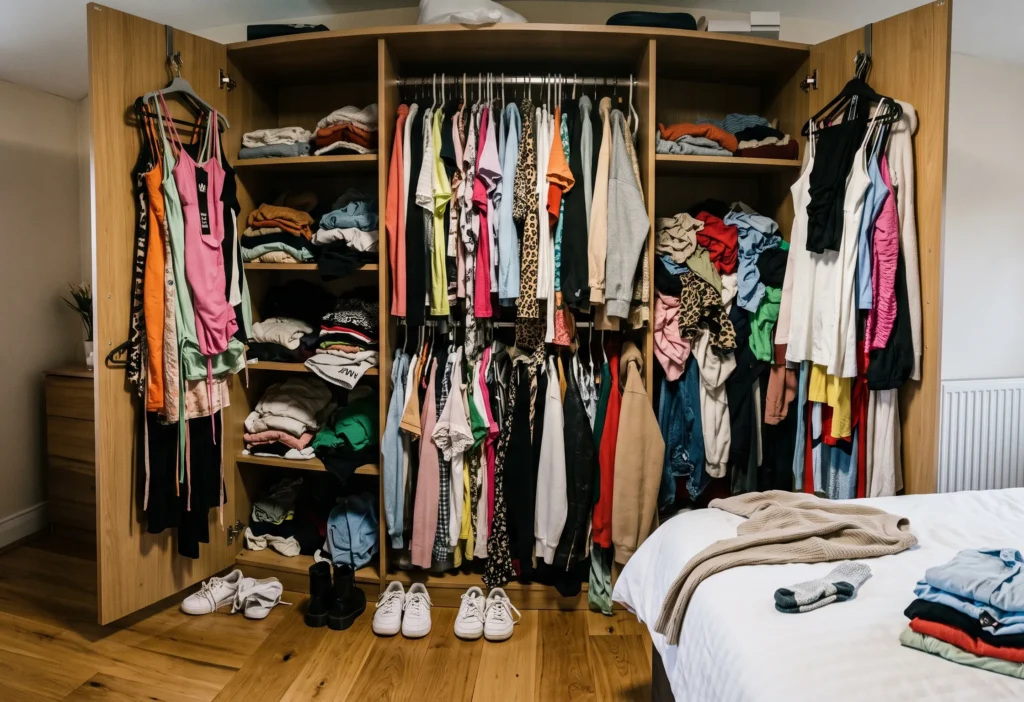
What is marketed today under the guise of “personal style” is a massive illusion that has turned millions of women into carbon copies of one another. In this era of speed, which forces consumers to stay relevant by churning out a new micro-trend every week, the streets have surrendered to an astonishing uniformity. This dictatorship of endless renewal is not limited to clothing; it permeates every cell of our existence, from cosmetics to how we present ourselves in the digital world. As psychologist Carolyn Mair underscores in The Psychology of Fashion, the anxiety of chasing trends strips the individual of the freedom to build an authentic identity. In the midst of this consumption hysteria, the greatest luxury of the modern age is to be completely “immune” to it all.
Fabricated Piles and the Consumption Dead End
The rush to keep up with trends turns our wardrobes into soulless depots of rapidly consumed items. The fabricated goods we pay exorbitant amounts for—merely for the popularity of the label attached to them—are nothing more than piles of low-quality fabrics that lose their shape after a few washes. Poured out in seconds from mass-production assembly lines, these garments are not designed to accompany you for years, but to become trash in a few months, dragging you back to the store. This cycle of fake novelty builds a shallow addiction to consumption rather than cultivating an enduring style.

This is precisely why there is a quiet but immensely powerful awakening against this shallow race of consumption. According to The State of Fashion reports by The Business of Fashion (BoF) and McKinsey, consumers are now exhausted by this meaningless micro-trend fatigue. The data points to a very clear reality: people are stepping away from those exhausting weekly currents and shifting their budgets toward investment-focused pieces that will retain their form for years. The consumer is rejecting the system’s “buy and discard” dictates, reclaiming the sovereignty of their own wardrobe.
The Global Return of Crochet and the Imperative of Durability
With this awakening, the invisible and quiet era of crochet in fashion has definitively ended. Crochet techniques, born hundreds of years ago entirely for durability and functionality—to achieve the longest lifespan at the lowest cost—have today transformed into the primary force shaping the windows of the most luxurious brands. This craft, which emerged as a necessity in the past, now forms the heart of fashion’s resistance against the epidemic of low quality. With its character that synthetic replicas can never achieve, crochet stands as the strongest monument erected against exhausting trends.
For this reason, this craft must never retreat into silence again; because in the modern world, durability is no longer a romantic preference, it is an absolute necessity. We are slowly losing our world to textile graveyards and mountains of low-quality fabrics. Instead of abandoning piles of fabricated goods to their fate and buying new ones, making room in our wardrobes for handcrafted items that defy the years is no longer just an aesthetic choice, but an intellectual reflex. True environmentalism is not about buying organic-labeled products every season; it is about eliminating the possibility of throwing a garment in the trash altogether.
Not Just a Material, But a Discipline of Craft
The secret to this durability is not simply about choosing the right yarn. Of course, premium materials form the foundation, but the real difference lies in the unparalleled meticulousness of boutique production. That “human touch,” lost in the assembly-line production of giant factories, is consciously channeled into every stitch in boutique craftsmanship. A piece being meticulously prepared by a single artisan, with millimeter-precise calculations and a discipline of craft meant to defy the years, breathes a noble soul into the work that machines can never provide.

Flexibility Seeping into Every Aspect of Life
This discipline of craft makes crochet far more versatile than we think, not only aesthetically but also in its scope of use. The biggest misconception regarding crochet is the conditioned belief that these premium pieces can only be worn at the beach or outdoors. However, combined with the right production technique and a cooling luxury texture, this craft can fit seamlessly into every part of life. Instead of low-quality loungewear that ends up in the trash after three washes, a crochet piece crafted with the right materials can offer a level of comfort suitable even for sleeping. Crochet is not merely a display object paraded to the outside world; it is a multifaceted architecture that also serves the serenity and resting moments of its wearer at home.
This flexible scope of use is also the key to freeing your closet from unnecessary clutter. Just a few pieces, woven in the right color palette and a sturdy silhouette, allow you to create countless combinations by pairing them together. The goal is not to fill your wardrobe with the incompatible pieces of disparate trends, but to build foundational cornerstones—few in number, yet speaking in perfect harmony—with versatile uses. The powerful, functional whisper of craftsmanship simplifies complex wardrobes with precisely this kind of refined nonchalance.
The Promise of Slowness and Matrilineal Power
As design historian Hazel Clark emphasizes in her theory of Slow Fashion, “slowness” is not a weakness against the speed of the industry; it is the ultimate promise. In an era where everything produced quickly is consumed quickly, wearing a design that takes days to create is a solid armor woven against that destructive speed. This is a subtle, intelligent rebellion against the meaningless frenzy of consumption and the massive sums the industry pays for suffocating materials merely for the sake of luxury logos. In a world where speed is dictated, slowing down is the most noble choice.
This rebellion is also a reflection of the matrilineal production power that a woman builds with her own hands, from her own living space. Against the soulless walls of mechanized factories, every piece a woman brings into existence in her home, out of respect for handcraft, is a contemporary form of ancient wisdom. This boutique production model creates a natural belonging that refuses to let women’s labor be crushed in the gears of mass capital, instead drawing strength from its own roots to present that uncopyable elegance directly to the world. This is a quiet revolution, knitted stitch by stitch.

The Mental Independence of Immunity
A woman who possesses this sense of immunity does not experience the fear of “Am I outdated today?” when she opens her closet every morning. She is entirely confident in her own style and the quality of her handmade piece. The intellectual armor she wears against the shallow expectations of the outside world and the bi-weekly changing rules of display windows provides her with priceless mental independence. Choosing not to participate in that panic-stricken race of trends is not a defeat; on the contrary, it is a dignified stance that rejects the sovereignty of algorithms and successfully remains grounded in its own center.
When you stand in front of your wardrobe today, the questions you must ask yourself should be far deeper than the shallow words on billboards: Are the pieces on your hangers reflections of your own identity that defy the years, or are they merely temporary costumes the industry has rented to you for just two weeks? Every time you open your closet, do you put on a rushed and fleeting disguise trying to keep up with the endless trend race, or do you wear the quiet armor of your own history, proving that you are immune to the noise of the whole world?
A true and lasting posture begins with being able to step aside and reject the cheap hustle endorsed by the system. In an age where everyone struggles to look alike and the concept of quality dies on mass production lines, surrendering to the patient, powerful rhythm of craftsmanship requires courage. The real objective is not to be one of the ordinary, flawless copies dictated by the system, but to be the undisputed sovereign of your own style, wrapped in a masterpiece that defies the years with every single stitch.
Further Reading:
- Clark, Hazel. (2008). “SLOW + FASHION—an Oxymoron—or a Promise for the Future…? “. Fashion Theory.
- Mair, Carolyn. The Psychology of Fashion. Routledge.
- The Business of Fashion (BoF) & McKinsey & Company. The State of Fashion 2025 / The State of Fashion 2026.